by Marian Rose & John Seed.
John Seed:I
was at the Findhorn Foundation in April 1989, helping Joanna Macy with a
deep ecology facilitators' training workshop, when I met some women who
invited me to help prepare a rubric for The
Beltane Ritual. Beltane, one of the cross-quarter days, is a festival which falls between the
Spring Equinox & the Summer Solstice,
when, in olden times, People Made Love in the
Fields to invite Fertility
into the Earth.
(The cross-quarter days are cultural festivals that fall between, or cross, the four quarter days, or seasonal festivals, i.e., the equinoxes and solstices, which quarter the year into the seasons. - ed.)
We - a couple of local women, another woman from California, and myself - were preparing for this joyous celebration with the holding of hands of loved ones and bonfire-leaping. It was around that time that I first visited the neighbouring town of Forres and first saw The Witches' Stone.
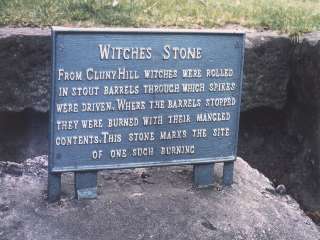
I was walking along an ordinary kind of pavement, with a retaining wall about 3 feet high between it and a grassy hill, when I suddenly came upon a boulder blocking half the pavement. It seems that when the pavement and retaining wall were built, this boulder had been carefully left half-buried there, and now was emerging out of the old structure. A corroded old bronze plaque was embedded in it, which, in raised letters, told the story of how, in not so remote times, that when a witch was discovered in the town, the people would take her to the top of yon Cluny Hill, place her inside a barrel and drive iron spikes into it, and then roll the barrel with the woman inside down the hill. The barrel and it's mangled contents would then be burned. This stone was the site where one such barrel came to rest.
I was, naturally, deeply disturbed by this artefact and its horrifying legend. I discussed it with Marian Rose, an American, who was co-designing the Beltane ceremony with us. I asked her to visit the stone, and then try to incorporate the experience into our Beltane Ceremony.
Marian Rose:
I was visiting Findhorn during the Spring of 1989, when a Scottish woman in the local community came to me, saying she had heard that I knew about The Beltane Dance Ceremony.
She wanted me to help her lead a Beltane Observance in the community, so she, and other locals, could connect with the ancient ceremonial traditions of her Celtic ancestors.
I was shocked to learn that no one at Findhorn knew the ceremony. I had learned it in the US, from a former Findhorn community member. This reveals just how tenuous are the links to our sacred heritage, and how easily hallowed traditions can be lost. I agreed to re-seed the ceremony at Findhorn, and John Seed joined us.
We had only a few weeks to prepare, and I was very busy with other projects. John kept asking me to come see this Witches' Stone he had discovered, but I was hardly interested: I didn't want to delve into the issues of the oppression of women surrounding pagan revivalism, since at this time I was taking a break from my feminist identity. However, John was insistent, so reluctantly I went.
From my native American teachers I had learned how to listen to the rock people who are the keepers and holders of energy. So, when we got to the stone, I knelt down and touched it, to connect with its energies. The minute my fingers made contact with the stone, I felt zapped. Images of fire and feelings of terror filled my body. I don't usually have powerful waking dreams, but instantly I saw the land scorched and scarred from the fires, and children screaming in distress. All of this happened in a flash, before I had even started to meditate as I had been taught. I have never had such a profound "shamanic" experience. Indeed, this Witches' Stone held great energy, and the intense jolt I received there deeply changed my life forever.
Seeing that we were in the middle of a busy street, John drove us back to our lodgings, but we didn't discuss the incident in any depth, because I was so overwhelmed by the experience, such that I was in a trance.
That afternoon, the experience and teachings from the stone just kept coming. I just cried and cried, and couldn't do anything else. I felt that I couldn't go on with my life. Here, I must explain that the sensations and emotions that shocked and distressed me so were not new ideas to me: I had read many accounts of The Burning Times, but until this encounter with the stone, I had only an intellectual understanding. But now, through the stone, I experienced it bodily, as if it were me and my own body that suffered martyrdom. The stone had stopped my life, taken me into death, change and transformation. That night, I told my colleagues that I couldn't see how I could go on with the ceremony, given my despairing and depressed state.
The Beltane is traditionally a joyous ceremony full of leaping for joy and dancing with the spirit of creativity represented by the fire. The fiery attraction of men and women served to support the fecundity of the earth and regeneration of crops. Any children born from this ceremony and sacred unions belonged to the whole community, and lived in the temples.
I felt, however, that it was impossible to lead a Beltane ceremony of love and joy between men and women in support of the earth, given that women's trust in men has been so deeply wounded, and that the Earth itself was scared by fire. Moreover, my confidence in the ceremony itself was shattered as I considered that these women, my elders in a ceremonial spiritual tradition that was regularly worked for healing and protection, were martyred by means of the very element at the centre of the rite. I was not like them, a Westerner unconnected to indigenous traditions and merely improvising techniques of honouring the land, healing, and sacred living. How could I serve the Healing of the Earth through doing ceremony, if the ancient communal rites employed by those wise and powerful women could not save them? If ceremony had any access to magic or power at all, how could this tragedy have befallen them?
Despite my crisis of faith, the Scottish woman and John Seed convinced me to continue with the ritual, due on the next day, since there was great community interest.
We revised the ceremony to
include:
* a remembrance for the martyrs of local witch hunts;
* a prayer for the healing of womenkind & of feminine energy itself;
* and,
a prayer for healing between men and women,
so that future Beltane Observances could be beautifully celebrated in the
traditional manner.
John Seed:
This was in April 1989, and as a rainforest activist, my mind was filled with the fires that were then raging in the Amazon. An area as large as Germany was going up in flames and I suddenly realised that there was no way that we could extinguish these fires as long as our culture continued to repress the history of The Burning Times.
In my experience as an activist, it seemed that we were always shoving sexist behaviour and patriarchal conditioning under the carpet, too busy trying to save the planet to take the time to work through this difficult material.
As a deep ecologist, I was wary of the human-centred agenda constantly trying to re-assert itself. I had dedicated my life to the interests of ecology as best I understood them, to the web of life itself rather than any strand in it. If the tree of life itself was dying, what was the use of tending to any of the leaves? Sure there were all kinds of social issues concerning justice and so on, but to my mind, this was all taking place on the Titanic and it was time to cry out "Iceberg dead ahead" and "All hands on deck" and leave these other issues aside till we had at least secured our life support systems.
But now I realised that the burning of the witches and the burning of the forests were two sides of the same coin and we needed to deal with both, that the ecological age could not dawn unless we dealt with our gender wounds at the same time as we worked for the Earth.
To cut a long story short, we revised our ritual. We still jumped over the fire, but first recounted the story of the Witches' Stone, and I sang Charlie Murphy's The Burning Times (see below). Also, Marian and I agreed to facilitate some workshops that we would call Gender& Deep Ecology. We did so a couple of years later in California and I have since facilitated this workshop on many occasions with a variety of co-facilitators.
Marian Rose:
After we had done The Beltane Ritual, a very interesting thing happened at Findhorn the next day. Several men from the community came to me and were concerned that by doing the "pagan ritual" we had hurt the land where the ceremony had taken place.
In a strange way I felt like a witch who was being psychologically burned at the stake for doing ritual magic that wasn't Christian in origin. I left Findhorn feeling that much work needed to be done to really heal the land and all women who work for the healing of the Earth.
Several years later, during a week-long Gender & Deep Ecology workshop led by John and myself, the Oakland hills were burning in the most devastating fire the Bay Area had experienced in years. Since we had no television, this news came to us from people joining us over the weekend. That synchronicity of the fire speaking so loudly was difficult to miss. Fire represents spirit and the creative essence: I believe that we must all learn to work the essence of fire - our creative spiritual selves - to create a world that honours all life, not just human life. Fire carries the essence of transformation which includes accepting death and rebirth. As humans, we must become like the fire: cleansing and transforming our human world, bringing forth a culture supportive and generative of life.THE BURNING TIMES by Charlie Murphy
Em D Em D Em
In the cool of the evening, they used to gather
D Em
'Neath stars in a meadow circled near an old oak tree
D Em D Em
D
At the times appointed by the seasons of the Earth
Em
And the phases of the moon
In the centre often stood a woman
Equal with the others and respected for her worth
One of the many we call the witches
The healers and the teachers of the wisdom of the Earth
The people grew through the knowledge she gave them
Herbs to heal their bodies, spells to make their spirits whole
Hear them chanting, healing incantations
Calling forth the wise ones ..celebrating in dance and song
Em D Em D
Em
Isis Astarte Diana Hecate Demeter Kali Inanna
Isis Astarte Diana Hecate Demeter Kali
Inanna
Isis Astarte Diana Hecate Demeter Kali Inanna
There were those who came to power, domination
And they bonded in the worship of a dead man on a cross
They sought control of the common people
By demanding alliegence to the church of Rome
And the pope declared the inquisition
It was a war against the women whose power they
feared
In this holocaust against the Nature people
Nine million European women died
And the tale is told of those who by the hundreds
Holding together chose their death in the sea
While chanting the praises of the Mother Goddess
A refusal of betrayal women were dying to be free
Isis Astarte Diana Hecate Demeter Kali Inanna
Isis Astarte Diana Hecate Demeter Kali Inanna
Isis Astarte Diana Hecate Demeter Kali Inanna
Now the Earth is a witch and the men still burn her
Stripping her down with mining and the poisons of their wars
But to us the Earth is a healer, a teacher a mother
She's the weaver of the web of life that keeps us all alive
She gives us the vision to see through the chaos
She gives us the courage it is our will to survive
Isis Astarte Diana Hecate Demeter Kali Inanna
Isis Astarte Diana Hecate Demeter Kali Inanna
Isis Astarte Diana Hecate Demeter Kali Inanna
Isis Astarte Diana Hecate Demeter Kali Inanna
Isis Astarte Diana Hecate Demeter Kali Inanna
Isis Astarte Diana Hecate Demeter Kali Inanna
Biographical Notes.
Marian Rose, MA.
Marian Rose is a leadership coach. She works with people in business, non-profit organisations and individuals to bring about change in their lives and in how they work. Specialising in women's and environmental leadership she integrates wisdom from indigenous cultures, Jungian psychology and Stanford's Graduate School of Business.
Ms. Rose has trained and coached executives at Fortune 500 companies, entrepreneurs founding start-ups, families, couples, parents and youth. Ms. Rose has been on a personal journey to re-indigenise her life for the last 15 years. Being from Arabic and European descent while living inCalifornia she takes a cross-cultural approach to reindigenisation.
Learning from Native American, Celtic, Bedouin and Taoist traditions she designs ceremonies for transformation and healing for individuals, groups and organisations. In 1986 a Native American elder asked Marian and others to create modern ceremonies for the people in the United States so we could remember how to in balance and harmony with the earth, each other, ourselves and spirit, i.e. all that sustains us.
Ms. Rose has a masters in Communication Arts and a certificate in Organisation Change from Stanford University's Graduate School of Business. She graduated Phi Beta Kappa with honours from the University of California at Davis.
John Seed
John Seed is founder and director of the Rainforest Information Centre in Australia. Since 1979 he has been involved in the direct actions which have resulted in the protection of the Australian rainforests. He has travelled around the world lecturing and showing films to raise awareness of the plight of the rainforests. In 1984 he helped initiate the US Rainforest Action Network which grew out of his first US roadshow. In 1987 he co-produced a TV documentary for Australian national television about the struggle for the rainforests. A front page story about John's work in the Christian Science Monitor referred to him as "the town crier for the global village". He has created numerous projects protecting 3rd World rainforests in Sth America, Asia and the Pacific through providing benign and sustainable development projects for their indigenous inhabitants tied to the protection of their forests.
He has written and lectured extensively on deep ecology and has been conducting Councils of All Beings and other re-Earthing rituals in Australia, North America Japan and Eastern and Western Europe for 15 years. With Joanna Macy, Pat Fleming and Professor Arne Naess, he wrote Thinking Like a Mountain - Towards a Council of All Beings (New Society Publishers) which has now been translated into 10 languages. He is an accomplished bard and has produced 5 albums of environmental songs. In 1995 he was awarded the Order of Australia Medal (OAM) by the Australian Government for services to conservation and the environment.