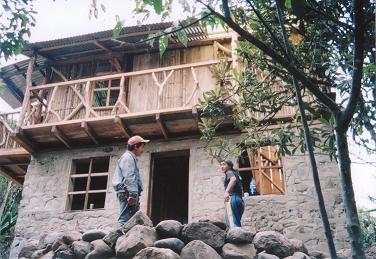
Volunteering in the Cloud
Forest – ‘El Milagro’, Ecuador.
By Anja Light, April 2009
In one of the world’s top ten hotspots of biodiversity, in the most biodiverse country on Earth, you are invited to live, learn and help us as a volunteer.
The ‘El Milagro’ project in Intag, Ecuador, is a 35 ha. cloud forest reserve and demonstration model of sustainable lifestyles based on permaculture principles. Volunteers are offered a range of experiences on site and in surrounding communities, supported by local guides, to protect and regenerate the cloud forest through sustainable development initiatives.
The El Milagro project began in 2000 as an initiative of the Sloth Club, Japan and the Rainforest Information Centre, Australia to work with the local community in demonstrating and supporting sustainable development initiatives in order to protect the surrounding cloud forest. To date over 100 visitors and volunteers have experienced a more simple, natural lifestyle at El Milagro and have made meaningful connections with local communities by sharing their willingness to help both the people and the forests.
There are thousands of volunteer projects all around the world, and many in Ecuador - what’s so special about ‘El Milagro’?
El Milagro is one of the few volunteer
placements that offers a complete ‘de-tox’ from modern urban life.
No electricity, a beautiful location, pure air and water, a simple, healthy
lifestyle with most organic food produced on site - a place where you can put
away your watch and follow nature’s rhythms. It helps you heal your separation
with nature. Visitors and volunteers leave El Milagro with new energy and a
clearer vision about how they want to live sustainably in the future. They gain
a deeper understanding of who they really are, why they are here and what they
can do for our planet.
As well as this, ‘El Milagro’ -
• Is located in one of the most beautiful places on Earth,
• Has a very comfortable climate,
• Is one of the cheapest volunteer placements in Ecuador,
• Lets you get involved with activities and campaigns to protect the cloud
forest,
• Encourages you to learn and practice Spanish,
• Allows flexibility to allow you to share your particular skills,
• Is open for individuals, couples and families,
• Supports the local community,
• Promotes practical, replicable and low cost sustainable solutions,
• Inspires you and teaches you the basic principles and practices of permaculture.
• Is connected with leading local and international organisations dedicated
to sustainable lifestyles and environmental action.
Costs
$200 per month for volunteers (includes basic food staples and food produced
on site), minimum 2 week stay to be paid in advance. Volunteers are encouraged
to contribute around 4 hours each day.
$15 per day for short stay volunteers (includes food). This is a not for profit
project, all contributions will support the ongoing maintenance of the site
and any excess will support community projects in Intag.
Long term volunteers (6 months onwards) are especially encouraged and can be
supported with assistance in gaining long term visas.
Demonstrating Solutions
The ‘El Milagro’ project in Intag hopes to provide an ecological example, based on permaculture design principles and experimenting with easily replicable and inexpensive ecological technologies. It is a place where international volunteers and visitors are invited to teach and learn and practice sustainable systems with local community groups. The vision is also of planting and maintaining permaculture gardens and collecting and distributing organic non-hybrid seeds to local people and reforesting degraded parts of the 35 ha of land that is part of the project so far.
The Intag region is world famous as a hotspot of biological diversity - one of the 10 most threatened on the planet - and is a vital area to protect. The El Milagro site is situated on a beautiful piece of land beside the river Tuabunche that flows out of the Cotacachi Cayapas Ecological Reserve. The area has also become famous as a place of resistance to destructive industrial development processes, such as mining. Through the efforts of local grassroots activists and international networks there has been great progress in developing alternative, ecologically benign projects to help local people raise their income and standard of living while reducing destructive development activities and threats.
It is also an area of inspiring political progressiveness. The entire population of Cotacachi (of which Intag is part) is invited by the local government to have a strong voice in the policies which affect them. One result of this political process is the declaration of the entire area as an 'Ecological County'. The strict set of environmental ordinances which lay the foundations for a very green future in this ecological jewel.
Promoting ecological understanding
and lifestyles is the probably the most urgent action to continue the progress
so far. Most farmers and colonisers still subsist from extremely destructive
practices - clearing and burning to grow marginal crops on extremely steep (erosion
prone) slopes. Like other extremely threatened or already degraded areas of
Ecuador, most people have no idea or information about sustainable land use
practices.
For more information about the Intag region and history of campaigns and actions
to protect the cloud forest please visit: http://www.decoin.org/
Arguably, the greatest threat to the remaining untouched cloud forest in the region has to do with the local people’s own choice about what kind of development they aspire to. Large scale industrial mining companies promise ‘improved lifestyles’ (better roads, jobs, health centres etc). Generally, local people aspire to increased cash income, that can mean more undestructive farming practices and/or logging. In this author’s experience, local people and communities have been deeply affected by the commitment shown by international volunteers to help find better ways to live, as well as in their willingness to learn from local people about the self sufficient lifestyle they have had up till now.
Getting To ‘El Milagro’
The first step is to contact Aya Wada in Cotacachi (wadaaya@sloth.gr.jp - ph:
593 (0) 96 040 354 who runs the Kurikindi Ecology Centre in Cotacachi, to connect
you with our caretaker Luis Hidalgo (ph ; 593 (06) 2648 578) who will guide
you to the ‘El Milagro’ site. Aya speaks Spanish, English and Japanese.
Luis only speaks Spanish, so you will need to have at least a basic knowledge
of the language to be able to communicate with him.
From the capital of Ecuador, Quito, it takes around two hours by bus to reach the famous market town of Otavalo. From Otavalo it is another two hours by bus on a very picturesque journey ranging from 2500 mtres above sea level to 1500 metres above sea level following the Cotacachi Cayapas Reserve. You get off the bus at the small village of Pucara (a prominent pre-Incan civilization site scattered with sacred mounds or 'Tolas'). Pucara also has a range of sustainable development initiatives aiming to create an ‘eco-village’. This project is supported by a US based foundation and also welcomes volunteers: http://www.casainteram.org/pucara.html
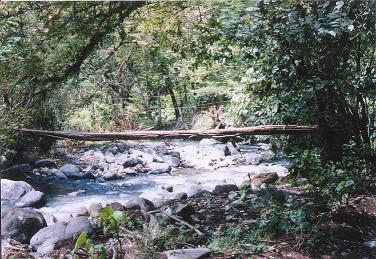
Guided by Luis, and with your luggage on horseback if you choose, you begin a 20 minute steep descent on foot to the project site. The Tuabunche river forms the lower boundary of El Milagro and is one of its greatest features, flowing fresh and pure water from the Cotocachi-Cayapas biological reserve.
El Milagro – Progress to Date
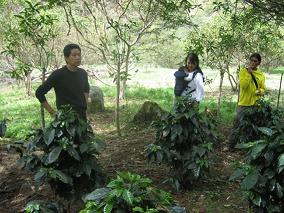
As of December 2000, the land has around one hectare planted out with a range of plants and fruit trees. As well as fruit and vegies, about 500 coffee seedlings have been planted as part of the organic shade grown coffee project that has received much support from friends in Japan. A water pipe system has been installed to provide water to the house and garden from the permanent small stream that runs through the property. A gas stove is available for cooking in the main house. An additional small dwelling is available for sleeping more visitors and volunteers. A greenhouse has been built to bring up native and fruit trees for reforestation efforts.
Building of a central house is complete (though we could use some help from a carpenter to build some cupboards and additional furniture!) , with the sugar cane grass roof and mud walls. The construction of the 'round' house follows ecological guidelines of using as many local materials as possible (mud walls, stone floor in kitchen and grass roof).
As of December 2008, the project is at its most comfortable yet. A second stone house has been built with the help of local people and volunteers. Permaculture gardens have been extended, a solar shower built and two solar panels for charging batteries have been installed. A Japanese style, wood fired soaking bath has also been built.
Ongoing volunteer activities from
April 2009:
Volunteers are needed to:
• Run mini-workshops for the local community on sustainable development
themes that they have knowledge and experience in (for example nutrition, natural
medicine, organic/permaculture farming, seed saving etc,) and environmental
themes for local communities depending on the skills and experience of visiting
volunteers.
• Maintain permaculture gardens and building structures
• Assist in ‘mingas’ and other community initiatives in surrounding
villages (guided by Luis Hidalgo, DECOIN and Peter Shear who coordinates the
Pucara eco-village project),
• Repair/renovate upper cabin
• Create a new pit toilet (behind round house)
• Maintain pastures (clearing weeds)
• Continue expanding permaculture design (eg. raised garden beds and pond)
• Extend agroforestry (coffee, native legumes, fruit trees and vines)
• Create and maintain existing walking paths to access both parcels of
land.
• Harvest and process organic coffee (for own consumption at El Milagro)
El Milagro Volunteer guidelines
Dec 2008
Costs
$200 per month for volunteers (includes basic food staples and local food),
minimum 2 week stay to be paid in advance. Volunteers are encouraged to contribute
around 4 hours each day.
$15 per day for short stay volunteers (includes food).
Longterm volunteers (over 6 months) are especially welcome and we can assist
in applying for long term volunteering visas
General Climate
El Mialgro is located at about 1800 metres above seal level, so there is a comfortably
cool climate all year round. Day time temperatures are about 25C, night time
about 15C. There is usually a rainy season (beginning around December till March)
and a drier season (August/September), however these seasons can no longer be
well predicted. It is usually fine weather in the mornings and very often rains
in the afternoons and night time.
General Needs
Light, easily drying long sleeved shirts and long pants (this is partly for
the climate, but mostly to protect from small black biting flies. These do not
carry any diseases but for some people can caue very itchy bites that can last
for days (there is calamine lotion in the medicine box for this). Insect repellent
is not very effective against these insects.
Head wearable torch/flashlight with extra batteries.
Biodegradable soaps and washing products.
Rubber boots (There are several pairs of rubber boots available at El Milagro,
so you are welcome to see if any of these fit before you need to buy new ones).
Comfortable walking shoes and sandles.
Luis Hidalgo
Luis Hidalgo from Plaza Guiterez is the general caretaker at El Milagro who
will help you with a variety of needs. Luis speaks only Spanish, which is great
for people wanting to practice their language skills!
Medicines
There is a medicine box in the kitchen that is stocked with basic medicines
and bandages. Please bring in any medicines that you may specifically need.
There are also a range of herbs growing (eg. Elderflower for cough, comphrey
for sprains etc) that you are welcome to use (herb book available in the library).
Kitchen
Vegetarian except for occasional fish (canned) and eggs (to be ordered in from
Luis).
Cooking is generally taken in turns and people who don’t cook clean up.
Lunch needs to be provided for the caretaker, Luis.
Compost and non-organic waste containers under the sink. We have to bury out non-organic waste, so try to limit bringing in non biodegradable items.
Please bring in any extra food preferences when you come. We provide basic staples and produce from the garden. If basic staples are depleted, write a list of needs that can be passed to Luis who will be able to bring things down the next day. This includes things like: rice, beans, lentils, oil, toilet paper, salt, sugar, etc. Luis will also bring in gas tanks if the gas for the cooker runs out.
All dishes need to be washed (and
put away preferably) before going to sleep. It may be easier to have early dinners
(around 5pm) so that cooking and cleaning can be done before it is too dark.
There are small mice around that will eat any food that is left lying around,
so please make sure all food is put away securely and the gas range is closed
at night.
Please use dishtowel for drying plates and a separate small towel for hands.
Please take care of all utensils and cooking equipment, replace anything that
is broken or lost. Use only the oldest pots etc. if you are cooking on the fire.
Sleeping
Beds and sheets are provided, please try to wash sheets before leaving.
It’s a good idea to hang your blankets and pillow in the sun when possible
to avoid any humidity or mustiness (the cloud forest has some of the highest
rainfall in the world).
Electricity
As a policy of El Milagro we are keeping of the electricity ‘grid’,
so you will find no fridge, lights or TV here.
Two solar panels provide energy for simple needs, such as recharging batteries
etc. We recommend you bringing a wearable torch for night time reading and getting
around. Candles can also be used – but please take care to blow them out
before sleeping.
Bathroom/washing
There is a laundry washing area that is also useful for washing hands, face
and brushing teeth etc. Please try to bring in only gentle, biodegradable products.
Solar shower is available (red tap above) – though there needs to be sun
in the morning for it to work effectively.
The bath tub is Japanese style – that means, please wash yourself completely
and thouroughly BEFORE going in the water so that the water can be used by other
people as well.
The river is also a great place for day time washing!
Toilet
This is a composting toilet so toilet paper can be thrown in. Please keep bucket
filled with humus (to be found further up the little stream) so that a cup of
humus can be thrown in the bowl each time you visit the toilet.
You are also welcome to bring in your own ‘night bucket’ for pee.
Citrus trees (lemon, orange, mandarin etc) thrive on urine – so feel welcome
to keep them fed!
Gardening
Many volunteer activities in Milagro centre around maintaining the permaculture
gardens. You are very welcome to bring in seeds and cultivate and experiment
with your own favourite plants and vegies.
Tools
Tools are stored in the small storeroom. Please take care of them and put them
away after the work day.
Travelling
You are welcome to leave El Milagro to use the internet and other services in
Apuela or Otavalo, although the days you leave El Milagro are not refundable.
There are buses that pass by Pucara around 6.50am, 7.50am. 8.50am around midday
and about 3pm. These times are not reliable and seats are not guaranteed, especially
if you are travelling from Friday to Sunday.
Communication
There is no telephone or mobile range at El Milagro. We have a two way radio
that can be set up to communicate with neighbours Carlos and Mary Ellen, however
theirs have to be turned on too to be able to function. Luis can pass on urgent
messages, otherwise a walk to Pucara, Plaza Guiterrez or in emergency to Carlos’s
house is the best way to communicate.
Diary.
Please remember to right a comment in the diary before you leave and also we
encourage you to keep your own diary about daily life in El Milagro.
Library
A wide range of books are available for you to read and study with while you
are here. Please make sure you keep this area in order while you are here and
return any books that you have been reading. We welcome any donations of books
too!
No alcohol, No drugs
Smoking only outside
El Milagro Blogs
Slow Moth Blog, El Milagro 15 Sep 2008
This message is powered by the sun!
Yes, finally the solar panels are connected to the inverter and charging up
the laptop. Like everything in Ecuador it took about three times longer than
expected. And now that I have the computer here, ready to write, I find it so
hard to stop doing the hundred other small but important tasks that keep El
Milagro and our simple lives ticking along – picking coffee, harvesting
peas, de-husking peas, washing clothes, making paths, planting, digging, pruning,
cooking, helping the kids with school work, washing clothes (yes, again!), putting
on roofs, fixing toilet houses…there is never really ‘nothing to
do’. Yet most of the activities are somewhat like meditation – mundane
and repetitive so that my mind to drift backwards and forwards in time, reflecting
and then making plans and then being blissed by the sight of an incredible looking
insect or bird.
It’s interesting to look back on the first lists I made of things that
needed to be done here and to watch as the priorities have changed. First I
thought we would really need to put glass in all the windows where we sleep/live
upstairs in the stone house. Then we had a morning visit by a beautiful hummingbird
and at night the fireflies flash in different parts of the room – so the
glass has remained packed in cardboard and we put an extra blanket on for the
cool nights.
We did meet one important priority - replacing the sugarcane grass roof of the
round house. Hooray – its finished! Between Luis and I and about 4 other
occasional workers, over the course of about 4 weeks, we stripped off the old
roof – to be used as mulch for the new gardens. In Australia sugar cane
mulch is bought in the big hardware stores by aspiring city gardeners –
here they would have burnt it if I had not stopped themand assured them that
it would be good for the garden. It seems that summer has finally arrived –
more than a month late – and it will be good to keep more moisture around
the new seedlings (brocoli, silverbeet, chili, tomato, coriander, parsley, white
carrot) that we have recently planted out.
The unusually wet weather was the main topic of conversation by most of the
people here for weeks. People had never remembered another time like it. It
affected the flowering and harvest of important local crops including coffee,
peas and beans. Local people commented on the impact of climate change –
and I bristled at the knowledge that this problem, caused by us rich consumers
in the energy wasting ‘developed’ countries, means suffering for
the poorest of the poor. We can go out and buy our food, while people here have
less choice, if the harvest fails because of too much rain, they don’t
have enough product to sell and they have less to eat.
Everyday we are reminded that we are truly in one of the most beautiful parts
on the planet. Pacha and Yani are always discovering new bugs which they bring
to me in glee. The sight of a big spider (even in the house) is not cause for
alarm but an exclamation of surprise and joy. We have seen a few snakes, including
a big false coral snake, resplendent in orange, red and black and a small black
snake that Pacha brought to me wrapped around a stick. I guess she thought that
my directive never to touch a snake didn’t apply to snakes less than a
meter in length! Anyway, it didn’t seem to be dangerous and we quickly
put it back where we found it. We have seen the famous cock of the rock bird
near the river, flashing red in the trees. We watch the squirrels in the trees
sharing the hundreds of guavas with us and our horse Shanti. Yesterday morning
we saw what must have been an opossum ambling along the newly laid stone path.
And about a week ago Pacha saved a baby duckling at the river side. Its mother
(or father) was a beautiful orange and grey blue colour and turns out to be
very rare here. A dog that had been following us to our regular swim in the
river ran ahead and grabbed the duckling in its mouth, Pacha wrestled it out.
We tied up the dog and put the duckling back by the stream, observing from a
distance as its parent came back…
Pacha and Yani have both been practising their riding skills on Shanti everyday.
Despite being a fullblooded stallion, Shanti follows Pacha around like a dog
and waits every morning at the gate in the paddock for Pacha to bring him a
bucket of guavas that have fallen during the night. Local people here have never
seen horses that get brushed daily and cuddled and kissed…but then, they
also do not expect stallions to be so placid with small children. This morning
we saw Shanti do a hilarious thing. He stood outside the round house where there
is a large window and he can see his own reflection. He started neighing and
whinnying and trying to nip the window – I guess Shanti sometimes feels
lonely here with only ocassional visits of other horses for company.
During the past month we have also been able to meet up with many old cherished
friends from Intag. A few weeks ago we got a lift with our neighbour Carlos
Zorilla and a car load of other neighbours to the hotsprings at Nangulvi (about
30 mins away by car) . The occasion was an agro-ecology fair (organised by the
‘consortio’ made up of DECOIN, AACRI and the Women’s association)
that reminded me strongly of the expos we had organised in Cotacachi. About
50 stalls with information, ecological products and delicious food, talks, local
musicians and of course the hotsprings. Pacha and Yani spend 3 hours in the
water while I met many old friends from the past. So many wonderful new initiatives
have been happening here, despite (or because of?) the threat of mining. It
has been hard for many people, yet I felt a sense of real optimism and solidity
about the initiatives. Projects like the coffee and kabuya handicrafts have
proved to be a real success and there are a range of new initiatives that mean
more diversity in the potential to provide a sustainable income and healthier
lifestyle. It was a great fair, though too expensive for many local people to
participate ($2 per person when a daily wage is only about $7 per day) and it
was hard to reach the fair without your own transport (only a few overloaded
buses travel the road each day). After Pacha and Yani could finally be coaxed
out of the water we ate lunch served on non disposable plates – a real
reflection of commitment to minimising environmental impact, pretty unusual
in Ecuador.
Every two weeks or so we have made the 1 hour walk and 2 hour journey by bus
on the dirt road to the market town of Otavalo. We book a room at a cheap but
clean hostel, where we shed the sweaty muddy clothes and shoes, soak in a steaming
hot shower and where the kids watch discovery kids in Spanish (one of the best
ways they have been able to pick up some of the language) while I work on the
first floor in the internet café, reconnecting with the world. We emerge
to have $1 pizza at the restaurant on the corner and the kids start to beg me
for the multitude of temptations we have not seen in the cloud forest –
ice cream, lollies, toys, hair clips, shoes, gloves…and I remember why
it is so very peaceful in El Milagro!
&&&&&&&&&&&&&&&&&&&&&&&&&&&&&&&&&&&&&&&&&&&&&&&&&&&&&
FEB 14 2006
Help protect the Cloud Forest of Ecuador - the most bio-diverse country on Earth.
Would you like to help communities
and protect forests
in one of the 10 hot spots of biodiversity on the
planet?
Would you like to live,
learn and help manage a
demonstration ecological lifestyle and permaculture
model nestled in the cloud forests of Ecuador?
'El Milagro' (the miracle)
is a burgeoning project to
create and demonstrate a replicable ecological
lifestyle to local, national and international
visitors and regenerate a precious cloud forest
ecosystem. It is a 35 ha. cloud forest reserve
containing a mixture of primary, secondary and cleared
forest (about 1 ha) bordered by the Tuabunche river
(that flows out of the famous Cotacachi-Cayapas
ecological reserve).
The El Milagro project in
Intag (Cotacachi, Ecuador)
aims to provide an ecological lifestyle model based on
permaculture design principles and experimenting with
easily replicable and inexpensive ecological
technologies from compost toilets, simple
hydro-electric systems, solar cookers and dryers and
biogas digesters. It is a place where you are invited
to teach and learn and practice sustainable systems
with local community groups.
We are now looking for a
long term volunteer (one or
more years) who would be willing to help coordinate
the project and help guide short term volunteers and
visitors to the site. The right person would be
supported with a reduced living cost fee and help in
obtaining a long term volunteer visa for Ecuador.
All volunteers need to have
a commitment to the
environment, to be reasonably fit and physical (not
scared of suspension bridges or steep cliffs), speak
some Spanish (Luis, the caretaker speaks only Spanish)
and be open-minded, inventive and self motivated. El
Milagro is a peaceful, secluded place (nearest
neighbours are about 1/2 walk away) where every
visitor finds their spirit lifted and filled with the
power and abundance of nature.
We now have two comfortable
and secure living areas
(an octagonal house with large balcony and traditional
mud walls, and a recently completed house made of
locally sourced stone and timber). Clean water from a
small permanent stream is on tap, a gas cooker helps
with cooking and a solar panel provides nighttime
lighting. The many fruit trees and garden plots ensure
a good supply of healthy, organic food. It is a one
hour picturesque walk (made easier with help from our
horse Shanti!) from the road to El Milagro with 5
buses a day passing by on their way to the famous
market town of Otavalo (2 hours drive and $2 fare).
El Milagro is located at
1800 metres above sea level
meaning year round cool comfort with daily
temperatures ranging from 10 degrees at night to 20
degrees during the day. Living costs are around $150
per month plus food (in addition to what the garden
provides). A permanent local caretaker, Luis Hidalgo,
is employed to work with and assist volunteers.
Our approach in assisting
the hundreds of volunteers
from around the world to help in a wide variety of
projects around Ecuador has always been to encourage
creativity, flexibility and freedom to apply specific
skill(s) and interests to the particular site.
At El Milagro we have had
volunteers with skills in
building, architecture and design, nutrition,
naturopathy, education, permaculture design,
horticulture, biology, documentary production and many
other interests that have made wonderful
contributions. It would provide a good base for a
book/thesis writing project or a base for
journalists/campaigners investigating issues such as
community resistance to destructive development (Junin
copper mine) and the progressive initiatives of the
County of Cotacachi (and its indigenous Mayor - more
below).
Over the past 2 years we
have organised seedbank
workshops at El Milagro for local and international
participants and have more planned for the future.
The permaculture design has been steadily evolving and
expanding and includes many fruit trees, vegetable and
cassava plots and around 300 coffee trees.
Our main organisational
links are with the Australian
based Rainforest Information Centre
(www.rainforestinfo.org.au) and the Sloth Club
Japan(www.sloth.gr.jp), both of whom provide web links
and support the project in various ways.
Volunteering at El Milagro
is a once in a lifetime
opportunity for an individual, couple or small family
to experience a new culture and make a positive
difference in the world. Living at El Milagro is a
step back (or forward) to a more simple, slow and
meaningful life - an experience that everyone should
have at least once in their lifetime!
For more information:
Anja Light, Rainforest Information Centre,
email pachalina@yahoo.com or phone 07 5534 4583.
Web page: rainforestinfo.org.au/projects/ecuador.html
or www.sloth.gr.jp
El Milagro Number 7 - July 2004
During the past few visits to El Milagro I have grown even closer to El Milagro as a vision growing into reality. I have also come to the decision to spend the next year or two (from the end of September) in Australia closer to my family. It is very hard to share this news and it is most important that you understand that it is not a feeling of abandoning El Milagro – actually, El Milagro is more beautiful and comfortable than ever! But it is what I feel is the best thing for me and my children right now. In a year or two Yani will be able to walk along the mountain paths by himself (saving my back) and I am sure life will be much easier! He has just had his 1st birthday (and now weighs 13 kgs) and while he can take quite a few steps, it will be some time before he can climb mountains. The challenge of growing up two very young children with no family or financial support here is too hard for me right now. I feel I will be able to be more productive for the Earth from Australia where I have a very good support network and all the opportunities to being more active in campaigns.
So, what we need right now is your help in coming to live at El Milagro or encouraging someone (or a small family) you know who would like to experience a Slow Life in the stunning Cloud forest of Ecuador for a year or more. It is a very important time in Intag, with the mining threat looming like never before and El Milagro may prove to be an important base for someone who can help share this story to the rest of the world. What we can now offer is a beautiful house with a solar panel and from October, a telephone line that will allow internet communications, along with productive soil and clean water and air and a friendly horse called Shanti!
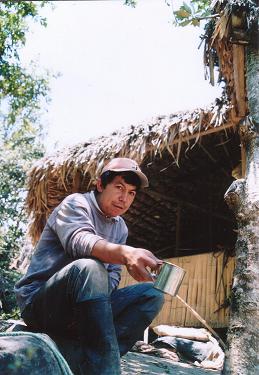
Over the past two months El Milagro has been graced by the very special presence of Kino, who has committed himself to finishing the creation of the house before he continues his travels. He is really part of the local community now, spending time with Luis and his family and the village of Plaza Guiterrez. He has also shared his healing skills with other visiting volunteers and filled many evenings with the beautiful sound of his guitar playing. We even had a chance to jam together the beginnings of a new song, especially for Yani. Shuji has also been helping us at El Milagro (and feeding his blood to the midges!) and Rie has arrived from Japan and has been a wonderful help. She passed the ultimate El Milagro test by carrying Pacha across the suspension bridges and then taking Shanti back to the farm from Pucarra by herself – complete with river crossings. I am sure it is the first time in her life she has ever done these things!
In the past month at El Milagro a most special experience for me was the early morning visit of a falcon to a perch just outside our bedroom window. He looked in at us just waking up to the glory of the day – it felt like he was inviting us to be part of his family. Or maybe he was celebrating the first birthday of Yani...We also have some very friendly squirrels who have been enjoying sharing our corn plants.
Little by little the house is emerging as an organic, rather eccentric, strong, comfortable home - complete with circular windows filled with green glass bottles. The major achievement this month was bringing in the large amount of timber needed for the roof and floors. It was incredible to witness 5 men carry 40 large beams down impossibly steep slopes over 3 days (the timber was too long for the horses to manage), with each of the beams weighing about 50 kgs. Intag people are built of steel I have decided – something you wouldn’t imagine looking at the slight build of the men. My job was making enough food to match their physical output. It is a great satisfaction to make a lot of food (soup,rice, beans, fried bananas, pop corn, orange juice, etc) and seeing every little bit eaten. It was also a great feeling to try to make each meal a little different, even though most of the ingredients are the same. We made it to Friday on the last of our food supplies and the conclusion by the workers (Luis, Fidel, Mauro, Cesar and Kino) that the meals were very good and they would be back next week to continue working on the house – which is always a very good sign.
I have now completely let go of any time limit for finishing the house construction (which I originally thought would be done by the end of June) – it will be another of the ever evolving growing parts of El Milagro I imagine! Hopefully we will be able to celebrate the completion (more or less) by the middle of August. Actually, this week, after the first beams had been placed on top of the concrete wall – we all came to the conclusion that it would be a waste to only have one floor on the building. The views are gorgious and we realised we have enough timber to build another level along with a balcony that will extend the small space of the 4m by 6m building.
Who knows, by next week we may decide to put yet another level on this ever changing creation!
So, this is El Milagro number 7 and I sincerely you will help us write future El Milagro reports and sustain the vision of a Slow sustainable lifestyle!
El
Milagro´
April 2003
Long Term Volunteer (6 months to 1 year) to manage this site urgently needed!
(Living costs only $50 a month). Would also suit student or writer looking for
a peaceful place for a sabbatical.
Nestled in the cloud-forested mountains of the region of Intag on the western
slopes of the Ecuadorean Andes, is a burgeoning project to create and demonstrate
a replicable ecological lifestyle to local, national and international visitors
and regenerate a precious cloud forest ecosystem. With support from the Sloth
Club in Japan (www.sloth.gr.jp), the Rainforest Information Centre in Australia
(www.rainforest.org.au) and a growing number of volunteers and individual supporters,
the Integrated Ecological Lifestyle Model project in Intag has been developing
steadily over the past 2 years.
The region is world famous as a hotspot of biological diversity - one of the 10 most threatened on the planet - and is a vital area to protect. The El Milagro site is situated on a beautiful piece of land beside the river Tuabunche that flows out of the Cotacachi Cayapas Ecological Reserve. The region of Intag has also become famous as a place of fierce resistance to destructive industrial development processes, such as mining. Through the efforts of local grassroots activists and international networks there has been great progress in developing alternative, ecologically benign projects to help local people raise their income and standard of living while reducing destructive development activities and threats.
It is also an area of inspiring
political progressiveness. The entire population of Cotacachi (of which Intag
is part) is invited by the local government to have a strong voice in the policies
which affect them. One result of this political process is the declaration of
the entire area as an 'Ecological County'. The strict set of environmental ordinances
which lay the foundations for a very green future in this ecological jewel.
Promoting ecological understanding and lifestyles is the probably the most urgent
action to continue the progress so far. Most farmers and colonisers still subsist
from extremely destructive practices - clearing and burning to grow marginal
crops on extremely steep (erosion prone) slopes. Like other extremely threatened
or already degraded areas of Ecuador, most people have no idea or information
about sustainable land use practices.
Demonstrating Solutions.
The Integrated Ecological Lifestyle Model project in Intag hopes to provide
an ecological example, based on permaculture design principles and experimenting
with easily replicable and inexpensive ecological technologies from compost
toilets, simple hydro-electric systems, solar cookers and dryers and biogas
digesters. It is a place where international volunteers and visitors are invited
to teach and learn and practice sustainable systems with local community groups.
The vision is also of planting and maintaining permaculture gardens and collecting
and distributing organic non-hybrid seeds to local people and reforesting degraded
parts of the 35 ha of land that is part of the project so far. Volunteers can
take part in this and have the opportunity to expand the project by investing
in the purchase of neighbouring properties.
The Place
Two hours on a local bus from the market town of Otavalo (two hours from Quito),
you reach the tiny village of Pucara (a prominent pre-Incan civilization site
scattered with sacred mounds or 'Tolas'). From here you look out to the 350
ha cloud forest reserve of 'La Florida' and in this direction begin a 20 minute
steep descent on foot. The Tuabunche river forms the lower boundary of the land
and is one of its greatest features,
flowing fresh and pure water from the Cotocachi-Cayapas biological reserve.
It is highly recommended that you contact or visit the Cotacachi Ecology Centre
(info. On website) first and make arrangements to be met and guided by the caretaker
(Luis Hidalgo) before visiting El Milagro.
Progress so far
As of December 2000, the land has around one hectare planted out with a range
of plants and fruit trees. As well as fruit and vegies, about 500 coffee seedlings
have been planted as part of the organic shade grown coffee project that has
received so much support from friends in Japan. A local person, Luis Hidalgo,
(and family, Mercedes, Clavers and Fernando) is employed to maintain the plants
and the property itself. A water pipe system has been installed to provide a
permanent water supply to the house and garden from the permanent small stream
that runs through the property. A gas stove is available for cooking in the
main house. An additional small dwelling is available for sleeping more visitors
and volunteers. A greenhouse has been built to bring up native and fruit trees
for reforestation efforts.
Building of a central house is now complete (though we could use some help from a carpenter to build some cupboards and additional furniture!) , with the sugar cane grass roof and mud walls. The construction of the 'round' house follows ecological guidelines of using as many local materials as possible (mud walls, stone floor in kitchen and grass roof). Cormac, from Ireland, came to Ecuador especially to help with this building project and has done a wonderful job! Other volunteers who have helped with this project include two friends from Japan - Taku and Kensuke who helped Luis with the gardens, and a New Zealand couple, Hans and Mikaela who have, along with Shine and Shannon, helped create a basic permaculture design. Recently (2003) the project has advanced dramatically through the help of Nancy Bradley who has also become an impromptu resident herbalist and naturopath for the surrounding community.
Future plans (within one year) include sourcing a solar panel to provide energy for laptop computer (and some lighting) and making a telephone connection to enable visitors and volunteers to access international communication on site. Ongoing activities include maintenance of the permaculture design gardens, carpentry, building a sauna by the river and planting more fruit and native trees.
Funding and the Future
The approach to funding with this project is to keep things small and simple
and create systems that are not expensive and easily replicable. Volunteers,
especially those who can teach appropriate technologies, are particularly sought
after to share their knowledge and vision. The initial land purchase was helped
by ecological friends from the Sloth Club in Japan. The deedholder and project
manager of the Rainforest Information Centre, Anja Light, has been paying for
the permanent local worker, house
construction and other infrastructure (from funds raised from forest CD sales
in Japan).
The long-term vision includes
the gradual expansion of the project site by encouraging visitors to buy neighbouring
parcels of land for reforestation, while focussing on the central land area
for self-sufficiency production. People living on neighbouring land usually
hope to sell so they can move to the city. Others would like to stay in the
area but are willing to take on different non-destructive farming practices.
The neighbouring
virgin cloud forest of 'La Florida' is a seed bank of native species that should
be allowed to reclaim its borders - it is with this ultimate vision that the
Integrated Ecological Lifestyle Model in Intag, El Milagro, was born.
Living Costs and conditions for Volunteers.
Living Costs are $100 per month (does not include food).
Many vegies are available on site and additional food supplies can be sourced
in the nearby village of Apuela. Living conditions are comfortable, simple and
secure. Beds, linen, washing clothes area, solar shower, kitchen sink with water
on tap, gas stove top, kitchen equipment are all available at the site, however
there is no electricity as yet. The site is situated at an altitude ranging
from 1500m to 1800m - which makes for a very comfortable climate (about 8 to
25 degrees celcius). Rainy season is from December to April but it usually only
rains in the afternoons and at night. There are several different walking tracks
to access the site from different directions, but there is no access by car.
Detailed information about visiting and living at the site and handy hints for
staying there are available below.
If you would like to find
out more, volunteer or visit this project, please contact:
cec@imbanet.net alight@ecuanex.net.ec
or pachalina@yahoo.com (Anja Light)